Ichimoku Research
TESTING IN PROGRESSIchimoku research isolates three progressively stricter crossover rules built on the Tenkan-sen (9), Kijun-sen (26) and the Kumo cloud (52-period Senkou spans, shifted 26). Each variant is simulated independently on a hypothetical $1,000 starting allocation and reported on the 4-hour and daily timeframes.
Variant A is free and public. Variants B and C are unlocked together by a one-time US$4.99 bundle giving 30 days of access across both the 4-hour and daily timeframes. Results are before costs; coverage limits and assumptions are noted below.
Enter when Tenkan-sen (9) crosses Kijun-sen (26): long on a bullish crossover, short on a bearish crossover. No cloud confirmation.
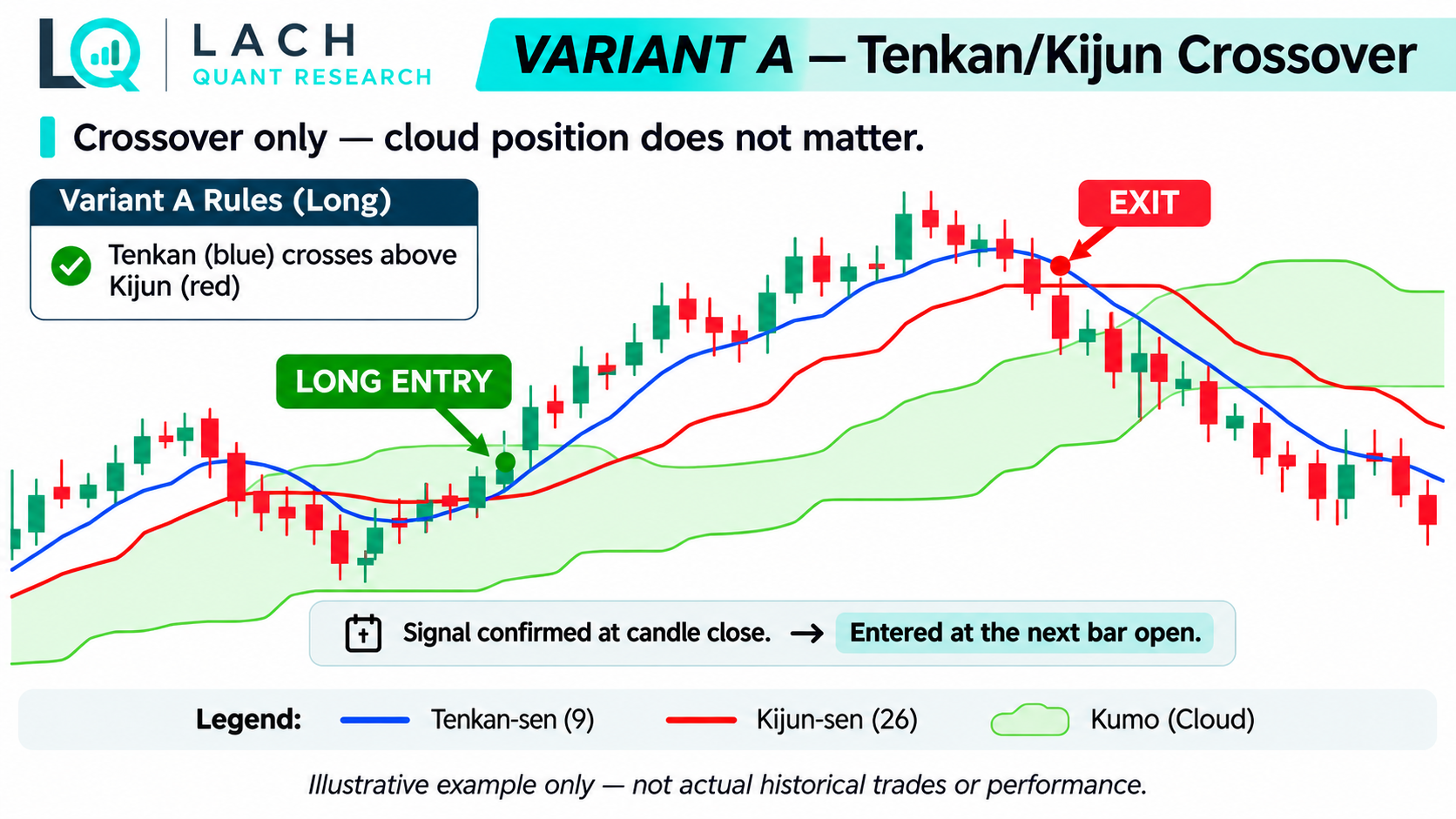
Illustrative example only — not actual historical trades or performance.
OPEN FULL SIZEDaily
PUBLISHEDVARIANT A · D1
Interactive daily simulation — equity, drawdown and trade-level detail. Free to view.
VIEW DAILY DASHBOARD4 Hour
PUBLISHEDVARIANT A · H4
Interactive 4 hour simulation — equity, drawdown and trade-level detail. Free to view.
VIEW 4 HOUR DASHBOARDVariant A plus the signal candle's close must sit beyond the displayed Kumo cloud.
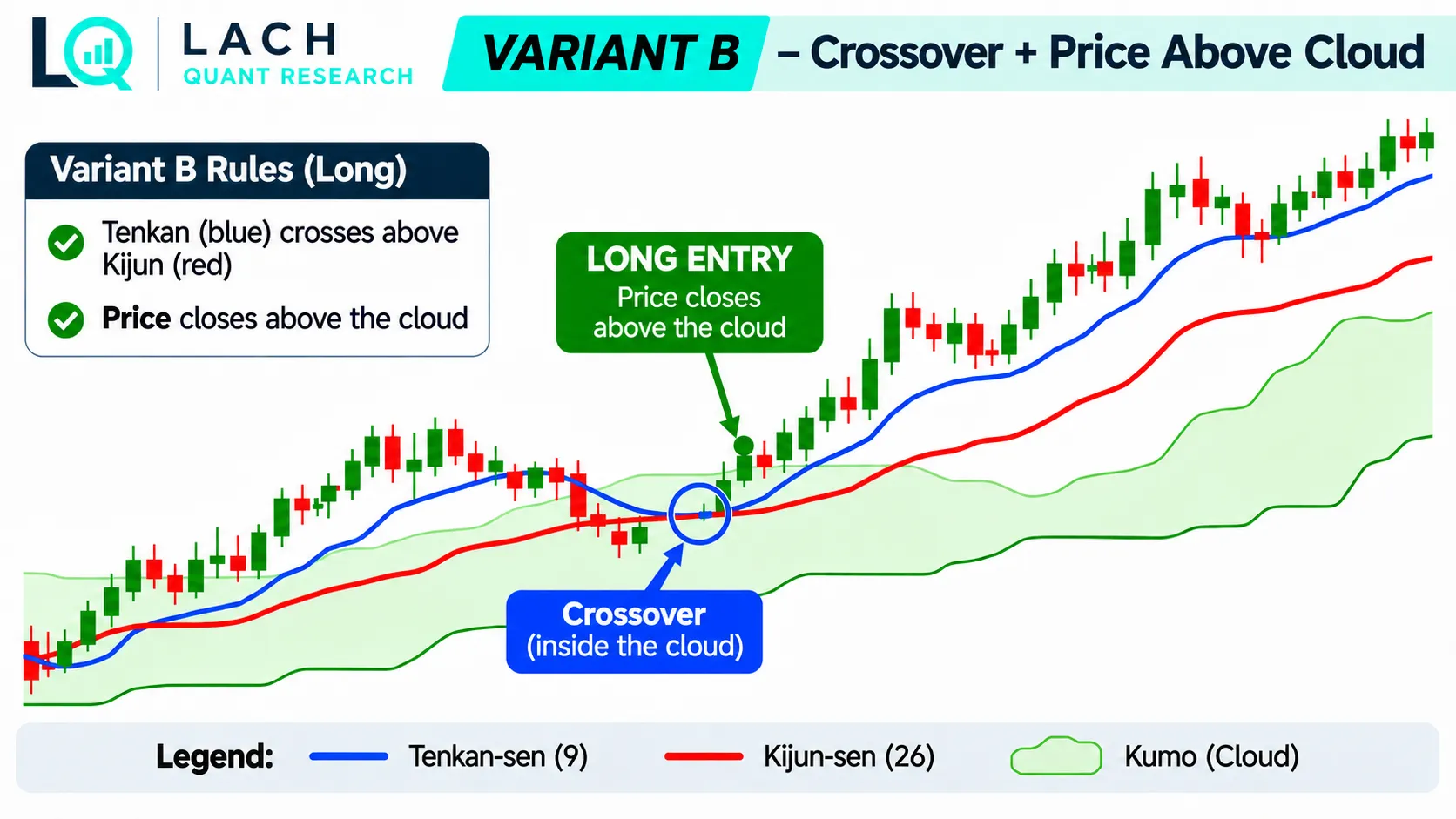
Conceptual illustration. The study applies the cloud condition to the signal candle of the crossover itself, not to a later bar.
OPEN FULL SIZEDaily
PUBLISHEDVARIANT B · D1
Interactive daily simulation — equity, drawdown and trade-level detail. Included in the US$4.99 30-day access bundle.
VIEW DAILY DASHBOARD4 Hour
PUBLISHEDVARIANT B · H4
Interactive 4 hour simulation — equity, drawdown and trade-level detail. Included in the US$4.99 30-day access bundle.
VIEW 4 HOUR DASHBOARDVariant A plus both Tenkan-sen and Kijun-sen beyond the same cloud edge (long above the cloud, short below it). The close itself does not need to be beyond both lines.
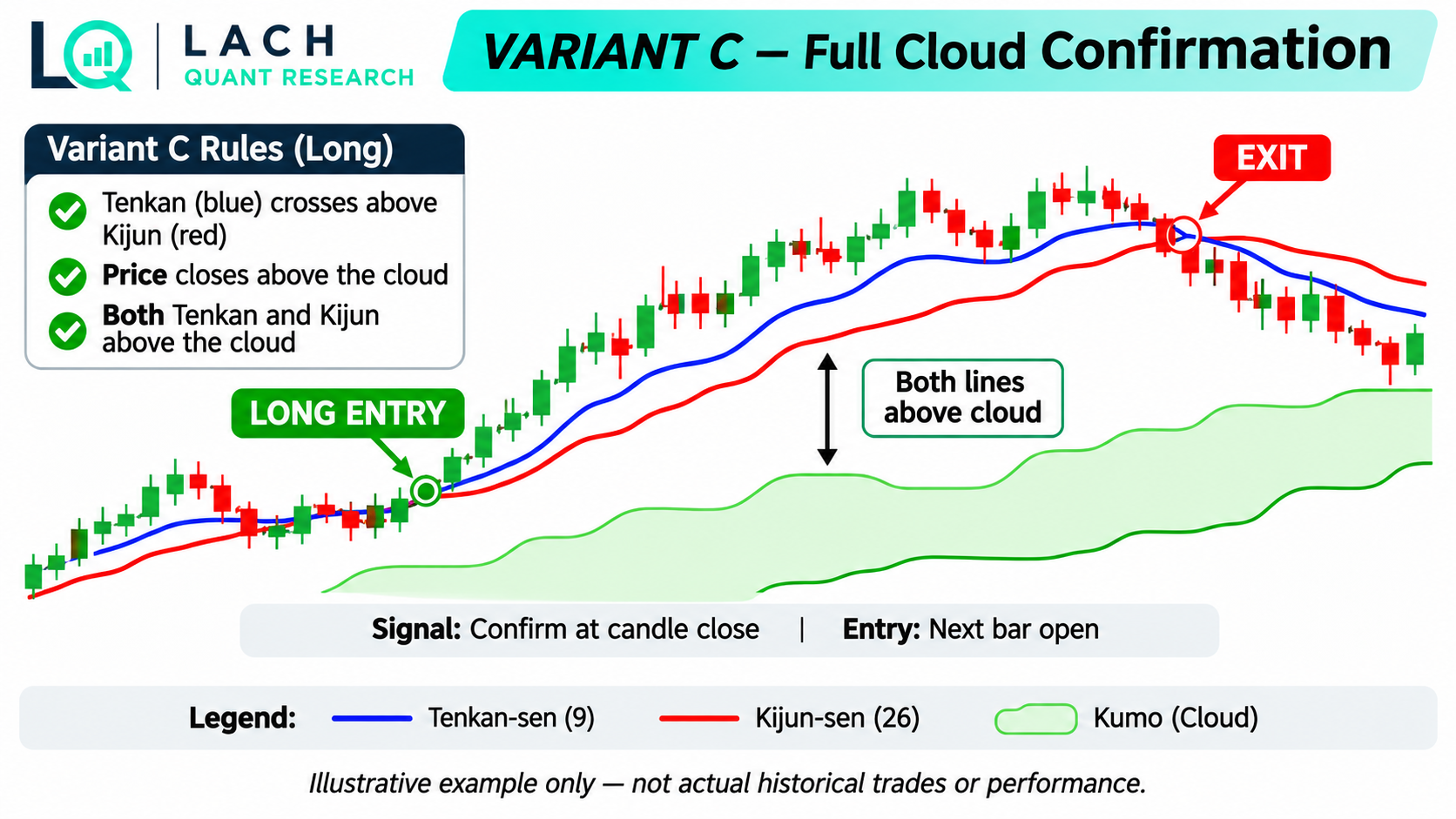
Conceptual illustration. The study rule is the crossover with both Tenkan-sen and Kijun-sen beyond the same cloud edge, not an additional price condition.
OPEN FULL SIZEDaily
PUBLISHEDVARIANT C · D1
Interactive daily simulation — equity, drawdown and trade-level detail. Included in the US$4.99 30-day access bundle.
VIEW DAILY DASHBOARD4 Hour
PUBLISHEDVARIANT C · H4
Interactive 4 hour simulation — equity, drawdown and trade-level detail. Included in the US$4.99 30-day access bundle.
VIEW 4 HOUR DASHBOARDData coverage
| GROUP | FROM | TO |
|---|---|---|
| Most FX pairs & metals | Nov 2021 | Oct 2026 |
| CHFJPY, GBPCAD, USDJPY | Jan 2024 | Oct 2026 |
| ES, NQ (index futures) | Jan 2021 | Dec 2025 |
Portfolio interpretation
- Each selection starts with a hypothetical $1,000 split equally across the selected instruments — not per trade.
- Allocations compound independently at their own entries, with fixed units until exit and no cross-instrument rebalancing. Skipped trades stay in cash.
- Year/month filters select ENTRIES but keep each trade's full original exit, even outside the selected period. This is entry-cohort analysis, not returns earned strictly within the selected calendar interval.
- The full study timeline is preserved so idle periods are explicit.
Assumptions & caveats
- Starting $1,000 is a normalization amount, not an executable minimum account capital.
- Fractional units are permitted. No fees, spreads, slippage, financing, margin or contract rounding are modelled.
- 1× notional exposure at entry — this is not 100% capital risk.
- Futures adjacent-contract-gap adjustment is a research proxy, not executable roll fills.
- Indicator exploration is in-sample, not independent out-of-sample validation.